How to Set Up an 80–100 TPH Sand and Gravel Crushing Plant in Haiti?
Quick answer.:An 80–100 TPH sand and gravel plant in Haiti is normally a six-stage fixed line: a ZSW490×110 vibrating feeder, a 1060×750 mm (PE-750×1060) jaw crusher, a PF-1315 impact crusher, a 3YK2470 three-deck screen, a VSI-1145 sand maker and a 2816 double-wheel sand washer with fines recovery, joined by 500–800 mm belt conveyors and powered by a 500 kW silent genset. The jaw is rated 180–220 TPH so it can swallow 500–600 mm quarry rock at part load, while the impact stage and the screen regulate the finished 80–100 TPH of 12–20 mm, 12–25 mm, 0–4 mm and 0–6 mm sand. The quoted ex-works price for this exact set is RMB 1,584,000 — USD 238,195 at 1 USD = 6.65 CNY — before freight, installation and taxes.
This guide is for the buyer who has already decided to produce aggregate locally — a quarry operator, a block plant, a ready-mix supplier or a contractor working its own gravel pits — and now needs the line to actually run: machine sizes in the right order, the arithmetic behind the 80–100 TPH rating, and the Haitian conditions that change the specification before the order is placed.
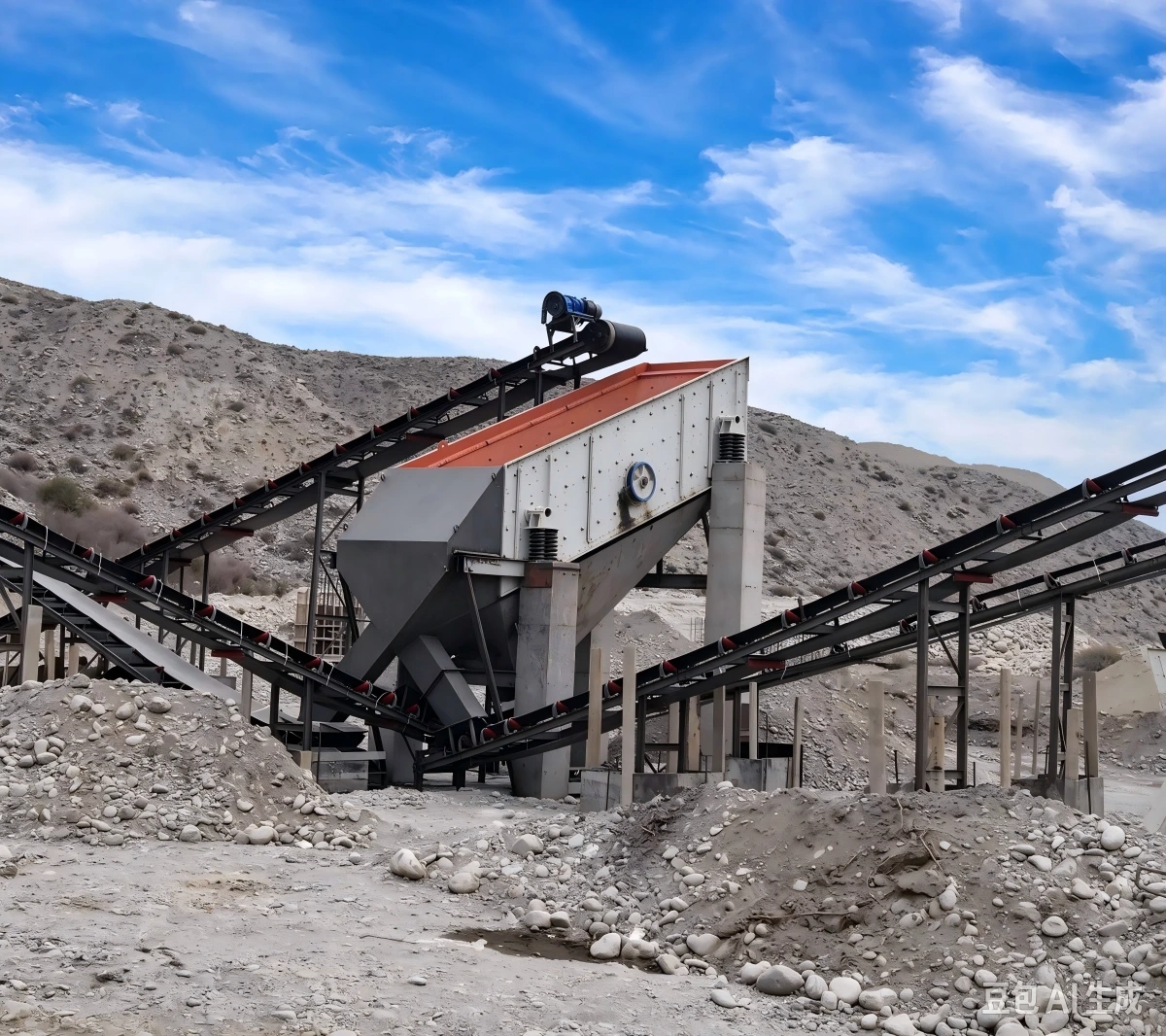
Line at a glance
Item | Detail |
|---|---|
Application | Crushed stone and manufactured sand for concrete, blocks and road base |
Target output | 80–100 t/h finished product; 1,000–1,500 m³/day of 12–20 mm in two shifts |
Feed material | Limestone, river gravel or basalt, 0–600 mm run-of-mine |
Finished products | 12–20 mm, 12–25 mm, 0–4 mm fines, 0–6 mm manufactured sand, return stone |
Installed load | About 769 kW connected; 390–460 kW in normal operation |
Footprint | 60 m × 25 m including four stockpile bays and a truck loop |
Crew | 8–10 operators and labourers per shift |
Quoted price | USD 238,195 ex-works China for this configuration (RMB 1,584,000 at 6.65) |
Delivery to site | 45–65 days from deposit, including 35–50 days at sea |
What does an 80–100 TPH sand and gravel line include?
An 80–100 TPH crushing and screening plant is not one machine but a chain, and every unit in it is sized against the unit before. Two numbers decide the whole layout: the largest lump the quarry can deliver to the hopper, and the smallest product the local market will pay for. Get either wrong and the line either chokes at the jaw or leaves a stockpile nobody buys.
The configuration below is the standard arrangement for a Haitian quarry supplying a 100 TPH market. Every unit is available new or used from the crushers inventory, and the same line can be quoted as a single package or stage by stage.
Table 1. Standard six-stage configuration for 80–100 TPH
Stage | Equipment | Rated output | Role in the circuit |
|---|---|---|---|
Feeding | ZSW490×110 vibrating feeder | 150–280 t/h | Metered feed; the grizzly scalps fines before the jaw |
Primary | 1060×750 mm jaw crusher (PE-750×1060) | 180–220 t/h at 80–150 mm CSS | Takes 0–600 mm quarry rock down to 0–150 mm |
Secondary | PF-1315 impact crusher | 100–130 t/h | Produces cubic 12–20 mm and 12–25 mm stone |
Screening | 3YK2470 three-deck screen | 80–300 t/h by deck | Four cuts: oversize return, two graded products, chips |
Sand | VSI-1145 vertical shaft impactor | 80–100 t/h | Converts 4–12 mm chips into 0–6 mm manufactured sand |
Washing | 2816 double-wheel washer + fines recovery | 80–100 t/h | Washes the sand stream, holds material under 75 µm below 5% |
One number in that table needs explaining before anything else makes sense. The jaw is rated 180–220 TPH while the plant is rated 80–100 TPH. That gap is deliberate. The jaw has to accept individual boulders of 500–600 mm at a rate the feeder cannot fully control, so it is sized on feed size and surge, not on finished tonnage. In normal running it works at 45–60% of rated load, which is where jaw plate life is longest and the belt drive is happiest. The impact crusher and the screen, which do the work that decides product quality, are sized on the finished 100 TPH instead.
Why 80–100 TPH is the right size for Haiti?
Haitian aggregate demand is being rebuilt from three directions at once: housing and block-making around Port-au-Prince and Cap-Haïtien, rehabilitation of the RN1, RN2 and RN3 road corridors, and reconstruction in the Grand'Anse and Sud departments after the August 2021 earthquake. All three consume the same two products in volume — 19 mm (3/4 in) concrete stone and a washed 0–4 mm fine aggregate — and all three are price-sensitive, because cement is imported and expensive while aggregate is the material that fills 70–80% of a concrete mix.
Most of the country's stone still comes from small pits and river-gravel operations running 20–50 TPH through a single jaw and a two-deck screen. That is enough for one block yard. It is not enough for a ready-mix plant that needs three graded sizes on the same day, and it is why buyers who win a road or housing package quickly run out of stock. An 80–100 TPH fixed line is the smallest configuration that can hold two coarse sizes in stock, produce sand on demand, and still load a 10 m³ mixer truck without a queue.
The second reason is power. A 100 TPH line sits inside the 500 kW generating class, which is the size of set that a Haitian quarry can fuel and maintain without a dedicated power station. Step up to 200 TPH and connected load roughly doubles, genset fuel per tonne climbs, and the spare-parts inventory grows faster than the revenue does. For most independent operators the 80–100 TPH band is the point where cost per tonne is lowest relative to capital at risk.
The third reason is transport. Port-au-Prince and Cap-Haïtien both handle 40 ft containers, but the inland roads that leave them punish anything oversize, and hauling raw rock is the most expensive tonne in the chain: 1 m³ of 600 mm boulder becomes roughly 0.6–0.7 m³ of graded product, so every kilometre you truck ungraded rock is a kilometre you pay for twice. Crushing at the quarry and trucking the graded product is almost always the cheaper arrangement.
Stage by stage: what each machine does and why this model?
The six units below are matched to each other by throughput and by opening size. Changing one without changing the others is how lines end up with a 200 TPH jaw feeding a 60 TPH screen.
1. ZSW490×110 vibrating feeder — metering, not dumping
The feeder is the least expensive machine in the line and the one that causes most of the stoppages. A 4,900 × 1,100 mm pan driven by a 15 kW motor moves 150–280 t/h, and its integrated two-stage grizzly bars take out the fines before they ever reach the jaw. On a Haitian limestone quarry that bypass is typically 10–15% of the feed, which is 10–15 t/h of material the jaw never has to crush.
- Pan width matched to the jaw. A 1,100 mm pan over a 1,060 mm jaw opening spreads rock across the full chamber; a narrower pan concentrates wear in the centre of the jaw plates.
- Variable-speed drive. Fitting a VFD lets the operator trim feed when the jaw chamber is full and speed up when the circuit is short of stone — the cheapest tonnage control on the plant.
- Wear liners, not a rebuild. Bolt-on pan liners and grizzly bars are consumables; ask for the liner part numbers and a price list before you sign, not after.
2. 1060×750 jaw crusher — the primary that sets the day rate
The 1060×750 jaw (sold as PE-750×1060) has a 1,060 × 750 mm feed opening, a closed-side setting range of 80–150 mm, a 110 kW drive and a rated 180–220 t/h. It is the machine that decides whether the plant runs a full day or stops every hour to clear a bridge.
- 750 mm chamber depth. A deeper chamber lets a 600 mm boulder sit down inside the jaws instead of bridging across the top — the single most common cause of stopped jaw circuits on hard rock.
- Set the CSS at 100–120 mm, not 150 mm. A tighter setting hands the impact crusher a easier feed, raises cubicity and lifts screen efficiency; the jaw loses perhaps 15% of nominal output, which the surge capacity absorbs.
- Jaw plates. 18% manganese, corrugated profile; flip top-to-bottom and rotate end-for-end before replacing, which typically doubles the wear life for the price of labour.
- What to verify on a used unit. Cracks at the toggle seat and frame corners, eccentric shaft runout, toggle plate and seat wear, bearing temperature history, and whether the jaw stock has been rebuilt with non-original plates. The jaw crusher buying guide sets out the full checklist.
3. PF-1315 impact crusher — where 12–20 mm and 12–25 mm come from
The PF-1315 is the product machine. Its 1,320 × 1,500 mm rotor, 200 kW class drive and 100–130 t/h capacity make it the standard secondary crusher for limestone and river gravel in this size band, and it reduces 0–150 mm jaw output to a finished 0–40 mm curve in a single pass.
- Two curtains set the curve. The upper and lower apron gaps control top size and the proportion of fines; on this line they are set so that 12–25 mm is the dominant fraction and recirculating load stays below 25%.
- Blow bars. Four-bar high-chrome rotor; rotate bars every 80–120 running hours and hard-face before the wear pattern reaches the rotor body. Bar cost per tonne is the single largest consumable line in the budget.
- Why impact and not cone here. For limestone and gravel with free silica below about 35%, an impact crusher gives better particle shape and a lower capital cost than a cone of the same output. For basalt or hard granite the trade-off reverses — see the cone crusher buying guide and the impact crusher buying guide.
- Dust. An impact crusher generates 15–20% more fines than a cone; budget for water sprays at the discharge and a settling pond, not a bag filter, at this tonnage.
4. 3YK2470 three-deck screen — the machine that decides your product mix
A 2,400 × 7,000 mm screen with three decks and 2 × 22 kW of drive is the standard sizing unit for this tonnage. Three decks give four cuts, which is exactly what the Haitian market asks for: an oversize return, two graded coarse products, and a chip fraction for the sand circuit.
- One mesh change switches the product. With the top deck at 25 mm, the second at 12 mm and the third at 4 mm, the line makes 12–25 mm. Change the top deck to 20 mm and it makes 12–20 mm. That is a half-shift job, and it is the reason one plant can serve a road contract and a block yard in the same month.
- Do not exceed 80% of rated capacity. A 3YK2470 running at 100 t/h is at roughly a third of its rated throughput, which is where screening efficiency stays above 90% and carry-over between decks stays low.
- Stroke and angle. 18–20° installation angle and 6–8 mm amplitude; if the screen blinds on wet feed, polyurethane media and a slightly steeper angle beat increasing the speed.
- Return circuit. Oversize goes back to the impact crusher on a dedicated 500 mm belt, not into the jaw, so the primary stage is never re-loaded with already-crushed stone.
5. VSI-1145 — 0–6 mm manufactured sand from 4–12 mm chips
The vertical shaft impactor closes the circuit. Fed with the 4–12 mm chip fraction from the screen, a VSI-1145 with a 1,145 mm rotor and 2 × 160 kW of drive produces 80–100 t/h of 0–6 mm manufactured sand at a fineness modulus between 2.6 and 3.0.
- Rock-on-rock beats rock-on-anvil in limestone. The rock box costs less to run, gives a rounder grain and avoids the anvil wear that dominates maintenance on abrasive feed.
- Cascade ratio controls fineness. Diverting 10–20% of the feed around the rotor changes the fineness modulus without touching rotor speed — the adjustment an operator actually uses day to day.
- Dust content matters more than grading. ASTM C33 caps material passing the 75 µm sieve at 5% for manufactured sand; without a proper settling pond and the 2816 washer with fines recovery downstream, a VSI will comfortably double that and the sand will be rejected at the batching plant.
- Power, not throughput, is the constraint. Installed load is 320 kW; on the 500 kW set the VSI should run as the last machine started and the first one shed.
6. 2816 double-wheel sand washer — the stage that keeps the sand sellable
Sand is only a product if it is clean. The 2816 double-wheel washer with an integrated fines recovery unit takes the whole 0–6 mm stream from the VSI, scrubs off clay and dust, and returns the useful fines that a plain wheel washer would lose to the settling pond. On Haitian limestone or river-gravel feed it is the difference between sand a batching plant accepts and sand that fails the 75 µm test on arrival.
- Wash water, not just water. Budget 60–100 m³/h of make-up water depending on clay content, and build the settling pond in three chambers so the plant can run a full shift without stopping to clean out.
- Fines recovery pays for itself. Recovering the 0.075–0.6 mm fraction typically returns 3–6% of the sand stream to saleable product — on 1,000 m³ a day that is 30–60 m³ that would otherwise be waste.
- Wheel washers tolerate dirty feed. Compared with a screw washer, the double-wheel machine keeps running at higher clay content, which matters where river gravel is dug from agricultural ground.
- Dewatering matters as much as washing. Specify a dewatering screen or a drained stockpile bay; sand sold at 18–20% moisture is sand the customer pays for but cannot use.
How 80–100 TPH becomes 1,000 m³ a day?
Buyers quote output in cubic metres and engineers quote it in tonnes, which is where most of the confusion in a plant quotation begins. Crushed aggregate runs about 1.5 t/m³ and manufactured sand about 1.6 t/m³, so 1,000 m³ of 12–20 mm is roughly 1,500 tonnes. The table below converts the three operating modes of this line into daily figures at the tonnages actually quoted.
Table 2. Output by operating mode, 80–100 TPH line
Operating mode | Screen setting | Hourly output | Shift hours | Daily output |
|---|---|---|---|---|
12–20 mm aggregate | Decks 20 / 12 / 4 mm | 100–130 t/h | 12–19 h | 1,000–1,500 m³ |
12–25 mm aggregate | Decks 25 / 12 / 4 mm | 100–130 t/h | 10–13 h | 800–1,000 m³ |
0–6 mm manufactured sand | VSI dominant, deck 3 at 6 mm | 80–100 t/h | 17–20 h | about 1,000 m³ |
Three practical readings of that table. First, the daily figures are shift-dependent, not machine-dependent: the same 130 t/h line produces 800 m³ on a single long shift and 1,500 m³ on two. Second, a mixed order — half 12–20 mm, half 12–25 mm in the same week — is a screen-media change, not a second plant. Third, sand is the mode that runs the plant hardest, because the VSI is the only stage in the circuit with no surge capacity behind it.
Site layout, foundations and drainage on a Haitian site
A fixed line needs three levels to work by gravity: the feed ramp at about +4.5 m, the crusher deck at +2.5 m and the screen deck at +6 m. Every metre of fall you build into the structure is a conveyor drive and a transfer point you do not have to pay for later, so the layout is worth settling before the first concrete is poured.
- Foundations. Haitian limestone is often karstic; probe for voids under the jaw and screen footings before design. Spread footings on 25 MPa concrete are normal, but the jaw frame needs a mass foundation, not a slab, and the anchor bolts should come from the crusher supplier.
- Wind and seismic. The country sits in a hurricane belt and on the Enriquillo–Plantain Garden fault system. Design the screen tower for a 200 km/h wind load, keep the structure unclad, and anchor the jaw and screen frames against horizontal movement.
- Drainage. The May–October rainy season will put 300 mm of water through the stockpile area in a day. Bund the yard, build a three-chamber settling pond of at least 15 m³ per chamber, and put a wheel wash at the gate — muddy trucks on a public road are how quarries get shut down.
- Stockpile bays. Four bays of about 500 m³ each, separated by concrete walls, with loader access from one side only. Shared access is the fastest way to contaminate a clean 12–20 mm stockpile with road base.
- Noise and dust setback. Keep the jaw and impact crusher at least 150 m from the nearest dwelling; at this tonnage water sprays and enclosure of the transfer points are cheaper than relocating a plant later.
Power: 60 Hz, EDH and the diesel decision
This is the specification detail that most often goes wrong on a Chinese line shipped to Haiti. Haiti's grid is 110/220 V at 60 Hz, following the US pattern, while Chinese-built plants are normally wound for 380 V at 50 Hz. A 50 Hz motor on a 60 Hz supply runs 20% fast, and a screen or a VSI — both of which are speed-sensitive machines — will change stroke, amplitude and bearing load rather than simply produce more.
- Order 60 Hz motors at the factory. Cheaper and more reliable than correcting it on site, and it keeps the warranty intact.
- Use VFDs on the feeder, the screen and the VSI. They accept either frequency, give stepless control, and pay for themselves in reduced mechanical wear.
- Size the genset on running load, not connected load. Connected load is about 769 kW; normal operation draws 390–460 kW, so the 500 kW silent set quoted below (about 625 kVA) is the correct class. It carries the running load with headroom for start-up, but not every motor at nameplate at once — the VSI is the last machine started and the first one shed.
- Fuel is a cost per tonne, not a cost per day. At 70% load a 500 kW set burns roughly 75–95 litres an hour; on a 100 t/h line that is 0.8–1.0 litre per tonne produced, which belongs in the feasibility numbers next to the blow bars.
The load list below is what the genset actually has to carry. Size on the running figure, then keep 15–20% headroom for start-up current on the jaw and the VSI.
Table 3. Connected load and genset sizing
Equipment | Drive | Installed kW |
|---|---|---|
ZSW490×110 vibrating feeder | 15 kW | 15 |
PE-750×1060 jaw crusher | 110 kW | 110 |
PF-1315 impact crusher | 200 kW | 200 |
3YK2470 vibrating screen | 2 × 22 kW | 44 |
VSI-1145 sand maker | 2 × 160 kW | 320 |
2816 sand washer + fines recovery | 15 + 7.5 kW | 23 |
Belt conveyors (7 units) | 5.5–11 kW each | 45 |
MCC panel, sprays, lighting | — | 12 |
Total installed | — | 769 |
Genset in this quotation | 500 kW silent, China Stage III | about 625 kVA |
What the line costs in 2026
The table below is an actual ex-works quotation for the configuration in Table 1, issued in November 2026 and converted at 1 USD = 6.65 CNY. Ex-works means the price covers the machines and their motors only — no freight, no installation, no taxes — so read the second column as the starting point of a landed-cost calculation, not as the budget.
Table 4. Quotation for the 80–100 TPH line, ex-works China, November 2026
Line item | RMB (¥) | USD at 6.65 |
|---|---|---|
ZSW490×110 vibrating feeder | 82,000 | 12,331 |
PE750×1060 jaw crusher, with 110 kW motor | 288,000 | 43,308 |
PF1315 impact crusher, with motor | 216,000 | 32,481 |
3YK2470 three-deck vibrating screen | 150,000 | 22,556 |
VSI1145 sand maker, with motor | 315,000 | 47,368 |
2816 double-wheel washer + fines recovery | 116,000 | 17,444 |
Belt conveyors, complete with frames, rollers, motors | 225,000 | 33,835 |
500 kW silent diesel genset, China Stage III | 192,000 | 28,872 |
Total, ex-works China | 1,584,000 | 238,195 |
Read against capacity, USD 238,195 works out to about USD 2,380 per tonne of hourly output — the figure to put next to any competing quotation, because a cheaper line with a smaller screen or no fines recovery is not the same machine set.
To land this set in Port-au-Prince, add 20–30%. Ocean freight for three 40 ft high-cube containers plus break-bulk or flat-rack space for the jaw, screen and genset is typically USD 45,000–70,000 from Shanghai or Ningbo; add marine insurance at about 1% of CIF, Haitian duty and the transaction tax assessed by the AGD, inland low-bed delivery, and six to eight weeks of erection with a local crew of 8–10 under a supplier's commissioning engineer. Civil works — foundations, ramp, retaining walls and the settling pond — are separate again and are usually quoted by a local contractor.
Shipping from China to Port-au-Prince
The six machines and the genset do not travel the same way, which is why a line ordered as one package still has to be planned as one shipping programme rather than eight separate shipments.
- Inspection and video record. Every unit is filmed with a time-stamped video — serial plate, run-up, no-load run, bearing temperatures — and the serial number is written into the contract.
- Contract and payment. Typically 30% deposit on signing and 70% against a copy of the bill of lading, with the inspection video as the release condition for a used line.
- Packing and container plan. The VSI, the 2816 washer, the MCC panel and the genset travel in 40 ft high cubes; jaw and screen frames go on flat racks or as break-bulk, braced separately, because a 9 t frame will destroy a container floor in heavy weather.
- HS classification. Crushing and grinding machines fall under HS 8474.20, screening and washing machines under 8474.10, and parts under 8474.90. Confirm the current Haitian rate with a local broker before the proforma is signed, because duty is assessed on the invoice value, not on what you expected to pay.
- Documents. Commercial invoice, packing list, bill of lading, certificate of origin, insurance certificate, and ISPM 15 fumigation marking on all timber packing. Haiti does not operate a pre-shipment conformity scheme equivalent to Nigeria's SONCAP, so documentation quality — not a certificate — is what clears the container.
- Sailing. Shanghai or Ningbo to Port-au-Prince with transshipment at Kingston or Miami, typically 35–50 days port to port, longer in the September–November peak.
- Customs and inland delivery. AGD clearance usually takes 5–10 days, then a low-bed to site; check bridge weight limits on the RN1 before booking a 40 t trailer.
Installation and commissioning: an eight-week schedule
A line of this size is erected, wired and commissioned in about eight weeks on a prepared site, assuming the civil works are finished and the anchor bolts have arrived with the machines rather than after them.
Table 5. Erection and commissioning schedule
Week | Activity | What has to be true at the end of it |
|---|---|---|
1–2 | Foundations, anchor bolts, feed ramp | Levels and centrelines signed off against the general arrangement |
3 | Feeder and jaw crusher | Jaw aligned, V-belts tensioned, guard fitted |
4 | Impact crusher and main conveyors | Rotors turn free, belts tracked, magnets and metal detectors live |
5 | Screen and VSI | Decks tensioned, screen angle set, rotor balanced and closed |
6 | Electrical, MCC, VFDs, earthing | Interlocks proven in no-load sequence |
7 | No-load run and water circuit | Eight hours no-load without abnormal temperature or vibration |
8 | Load test, gradation check, operator training | Products within specification, crew able to change screen media |
Five mistakes that cost Haitian buyers a season
- 50 Hz motors on a 60 Hz grid. The plant runs, then the screen bearings fail in eight weeks and nobody can explain why. Specify 60 Hz at the order stage.
- Sizing the jaw at exactly 100 TPH. The plant then has no surge capacity, and every oversized boulder becomes a stoppage instead of a slow hour.
- Buying the screen last. The screen sets the product mix and the recirculating load; it should be selected before the impact crusher, not after the budget is spent.
- No settling pond. Without water and a pond, the manufactured sand fails the 75 µm limit and the dust becomes a complaint from the nearest village.
- Importing a line without commissioning support. Eight weeks of local labour without a supplier engineer on site typically costs more in rework than the engineer's visit.
Frequently asked questions
The questions below are the ones Haitian buyers raise most often when they price an 80–100 TPH line, with the answers in the form they are usually needed: numbers first, conditions second.
How much does an 80–100 TPH crushing plant cost in Haiti?
The six-stage line specified in this article is quoted at RMB 1,584,000 ex-works China, which is USD 238,195 at 1 USD = 6.65 CNY — about USD 2,380 per tonne of hourly capacity. The price covers the machines and motors only; add 20–30% for freight, insurance, Haitian duty and inland delivery, then budget civil works, erection and the wash-water circuit separately.
Can one line produce 12–20 mm and 12–25 mm at the same time?
Not simultaneously from one screen, but sequentially within a shift. The 3YK2470's top deck is set at 20 mm for 12–20 mm product and at 25 mm for 12–25 mm; the second deck stays at 12 mm and the third at 4 mm. Changing the top deck mesh takes about half a shift, so most plants run one size for a week and switch on the order book.
What size rock can the 1060×750 jaw accept?
Up to about 600 mm, which is roughly 80% of the 750 mm feed opening. The practical limit is set by the boulder's shape as much as its size: a 600 mm slab will bridge where a 650 mm block will sit down into the chamber, which is why the feeder grizzly and a rock breaker at the hopper are worth more than a bigger jaw.
Do I need a cone crusher instead of the PF-1315 impact crusher?
Only if the rock is hard and abrasive. Limestone and river gravel with free silica below about 35% are cheaper to crush with an impact crusher, and the particle shape is better. Basalt or hard granite above that threshold will wear blow bars faster than a cone's liners, and the economics reverse.
How much sand can the VSI-1145 produce per day?
80–100 t/h, which is about 1,000 m³ in a 17–20 hour two-shift day at 1.6 t/m³. The limiting factor is usually dewatering and dust control rather than crushing capacity.
Is a fixed plant better than a mobile plant in Haiti?
For a quarry that stays on one site for more than 12–18 months, yes: a fixed line has a lower cost per tonne, a wider product range and simpler maintenance. A mobile plant wins when the work moves — road contracts with several borrow pits, for example. Many Haitian operators end up with a fixed primary and a mobile secondary for exactly this reason.
What voltage and frequency should I order for Haiti?
60 Hz, and motors wound for the supply you will actually run: 220/440 V if the plant runs on the grid, 380 V if it runs on a genset, or VFD-fed throughout. Do not accept a standard 380 V 50 Hz package and plan to fix it later — screen and VSI speed change with frequency.
How long does shipping from China to Port-au-Prince take?
35–50 days port to port, with transshipment at Kingston or Miami, plus 5–10 days for AGD clearance and one to three days inland. From deposit to a running plant, plan on 45–65 days if the civil works are ready when the containers arrive.
Can FairTradeMachinery supply the whole line as one order?
Yes. Feeders, jaw, impact and cone crushers, screens, VSI sand makers, conveyors and MCC panels are quoted as one package with a single shipping programme, one spare-parts list and one commissioning schedule. Used and new units can be mixed in the same line, which is how most buyers in this tonnage band keep the capital cost down.
About FairTradeMachinery
FairTradeMachinery is a used and new construction machinery exporter based in China, supplying contractors, quarry operators and dealers with inspected equipment sourced directly from Chinese owners and factories. The crusher range covers jaw, cone and impact crushers, VSI sand making machines, vibrating feeders, screens and complete fixed or mobile lines — all listed with year, hours and configuration on the crushers for sale page.
For a quotation on a configuration like the one in this article, send the feed size, the finished sizes you need to sell, the daily volume in cubic metres and the destination port through the contact page. Payment, inspection and shipping terms are set out under after-sales service, and the questions buyers ask most often are answered on the FAQ page.
Sam Hou · Senior Equipment Inspector. Sam Hou has inspected used construction and crushing equipment for export since 2013, covering frame and structural weld assessment, bearing and rotor condition, wear-part life and hour-meter consistency across jaw, cone and impact crushers.
Sources
- ASTM C33 / AASHTO M43 — standard specification for concrete aggregates and size numbering
- HS nomenclature, chapter 84, heading 8474 — machinery for sorting, screening, separating, washing, crushing and grinding
- Électricité d'Haïti (EDH) supply characteristics and the 110/220 V 60 Hz national standard
- Equipment specification sheets for ZSW490×110, PE-750×1060, PF-1315, 3YK2470 and VSI-1145, as published by Chinese manufacturers, 2026
- FairTradeMachinery shipping and inspection records for fixed crushing lines exported to the Caribbean, 2025–2026
Verification note. This article was compiled from manufacturer specification sheets, published standards and a written ex-works quotation issued in November 2026. The RMB figures in Table 4 are the supplier's own and the USD column is converted at 1 USD = 6.65 CNY; both move with steel, freight and exchange rates, and the price excludes freight, installation and taxes. Capacities are quoted on limestone-class rock at about 1.6 t/m³ and fall by 20–30% on hard abrasive rock. Obtain a written quotation against your own feed material before committing capital.






 Chat en vivo en Whatsapp ahora


 FAQs
 WhatsApp