Buying a Mining Excavator in Guinea: A Practical Guide to Tonnage, Condition, and Import Compliance
Buying a Mining Excavator in Guinea: A Practical Guide to Tonnage, Condition, and Import Compliance
Core conclusion: For a mining excavator in Guinea, the 30-ton class is the workhorse for bauxite and gold stripping — but the first gate when choosing a machine is not the brand, it is whether the remaining undercarriage life can withstand the wear of laterite mining. Guinea's mining conditions are dominated by bauxite laterite stripping and soft-rock gold mining. Equipment runs continuously in high-dust, high-humidity environments, making the undercarriage, hydraulic pump, and cooling system the high-failure areas. We recommend prioritizing 30-ton class machines built after 2018, with under 6,000 hours and over 60% undercarriage remaining, and specifying pre-loading video inspection checkpoints and a spare parts list in the contract.
Why the 30-Ton Class: Matching Machine to Guinea's Mining Conditions
Guinea's mining structure dictates the tonnage direction.
Bauxite is Guinea's core mineral, accounting for more than one-third of global output, with exports reaching 183 million tonnes in 2025. Bauxite mining is mainly open-pit stripping, where the laterite overburden is thick and sticky, requiring sufficient breakout force and a bucket capacity matched to the loading height of haul trucks. The 30-ton class offers the best balance of productivity and fuel consumption in this scenario, and it is also the tonnage segment with the largest used-machine inventory locally. At the same time, Guinea's gold projects continue to ramp up — for example, the Kiniero gold mine's processing plant reached 1,113 t/h in Q2 2026, about 50% above design capacity. Gold ore is softer than bauxite laterite, but the availability requirement is extremely high, and downtime losses far exceed fuel consumption differences.
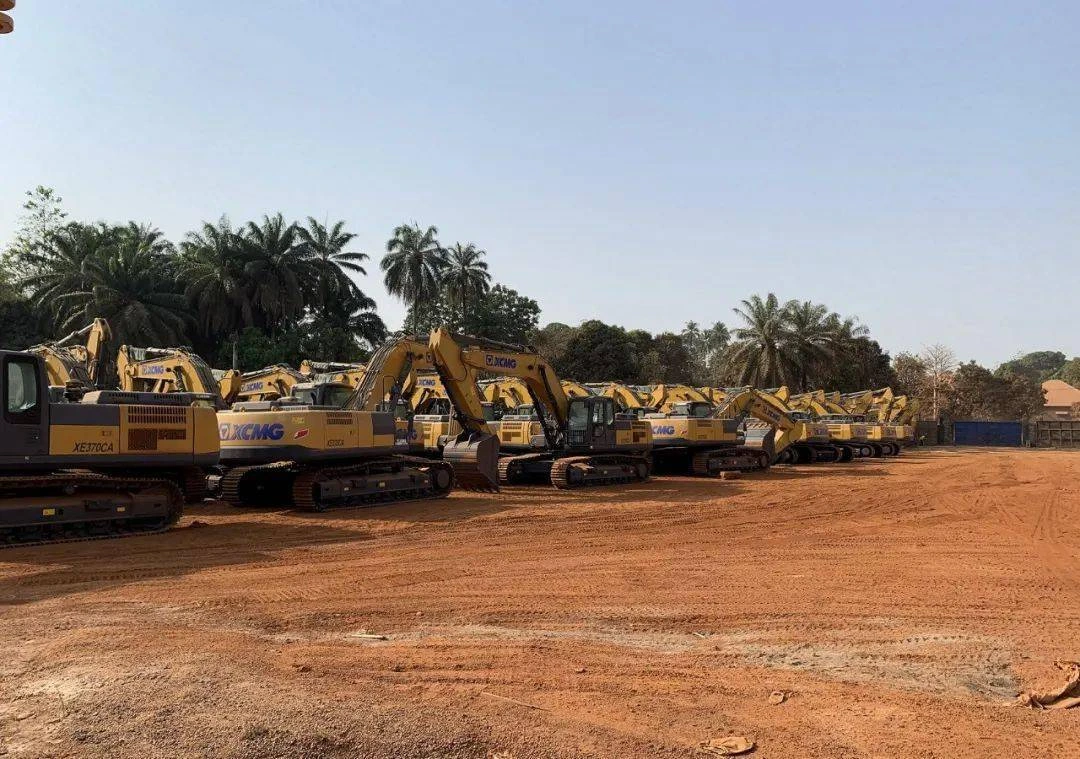
Practical recommendation: If your mine is mainly bauxite stripping, target the 30-ton class with a bucket capacity of 1.4 m³ or above and a reinforced boom; for gold or secondary deposits, 25–30 tons will do, but you must confirm hydraulic oil temperature performance under continuous load.
Table 1: Guinea's Main Mining Conditions and Recommended Excavator Tonnage Matching
Mine Type | Typical Working Conditions | Recommended Tonnage | Bucket Capacity Reference | Key Configuration Requirements | Selection Priority |
|---|---|---|---|---|---|
Bauxite stripping | Thick sticky laterite, high dust, continuous operation | 30–35 t | 1.4–1.8 m³ | Reinforced boom, high-capacity radiator, dust seals | Highest (largest inventory, most stable demand) |
Gold mining | Mainly soft rock, extremely high availability requirement, high downtime cost | 25–30 t | 1.2–1.5 m³ | Stable hydraulic oil temperature, main pump reliability, quick-coupler lines | High (project-driven, high unit value) |
Plant auxiliary / hauling | Short distance, fixed site, non-continuous load | 20–25 t | 0.9–1.2 m³ | Undercarriage remaining can be relaxed to 40%, prioritize low price | Medium (supplementary option on a limited budget) |
River / civil earthworks | Mixed soil, muddy in rainy season | 20–22 t | 1.0–1.2 m³ | Travel motor seals, water-wading protection | Low (not a mining mainline; configure as needed) |
How to Read Condition Evidence: Three Inspection Priorities in Laterite Mining
The most common trap for Guinea mining buyers is equating "clean appearance" with "good condition." Laterite dust hides leaks and structural cracks, and local repair capability is limited — once a major component fails, downtime is measured in weeks. Focus on three areas:
Undercarriage remaining life is the first priority. Laterite mining ground is soft and contains gravel, subjecting travel motors and track chains to large torque fluctuations. Ask the seller for measured track link height or undercarriage remaining percentage; anything below 50% should be ruled out directly — the cost of replacing a 30-ton class undercarriage assembly plus downtime will eat up most of the price difference. Also check track rollers and carrier rollers for oil leaks; laterite sticking to the roller bodies accelerates seal wear.
The hydraulic pump's "cold-start noise" is more honest than a spec sheet. Ask the seller to film a 30-second idle-running video after a cold start and listen for abnormal noise or metal friction from the main pump. Guinea's high humidity means excessive water in hydraulic oil can cause pump and valve corrosion; request the most recent hydraulic oil test report (NAS grade or water content). If there is no report, write "third-party hydraulic oil sampling before loading" into the contract.
The cooling system must be inspected with the core exposed. Laterite dust clogging the radiator is a common failure in Guinea mines, and excessive hydraulic oil temperature directly derates power. Ask the seller for photos or video of the radiator core after cleaning, and confirm the fan clutch operates properly.
Table 2: Condition Inspection Items and Acceptance Criteria for Mining Excavators in Guinea
Inspection Module | Specific Check Items | Acceptance Criteria (Recommended) | Walk-Away Signals | Inspection Method |
|---|---|---|---|---|
Undercarriage & travel | Track link height, track/carrier roller leaks, tension | Undercarriage remaining ≥60%; no roller leakage | Remaining <50%; roller leaks with abnormal noise | Measured track link height + undercarriage close-up video |
Hydraulic system | Main pump cold-start noise, control valve leaks, oil cleanliness | No metal noise at idle or full load; oil NAS ≤9 | Cold-start abnormal noise; obvious valve leakage | 30-second cold-start video + hydraulic oil sampling report |
Structural components | Boom root weld repair, counterweight mounting cracks, stick deformation | No weld repair, no cracks, original structure | Weld repair traces at boom root; loose counterweight bolts | High-resolution photos of four structural corners + walkaround video |
Cooling & electrical | Radiator core clogging, fan clutch, instrument fault codes | Clean core, no fault codes, A/C working | Oil temperature alarm history; instrument errors | Post-cleaning photos + instrument panel startup video |
Maintenance records | Parts replacement records, major overhaul history, hour meter cross-check | No major rebuild; hours match service records | Refuses to provide records; hours clearly abnormal | Service invoices + maintenance record verification |
Import Compliance and Logistics: No SONCAP in Guinea, but a Mining Tax-Exemption Channel
Guinea's import regulation differs from the English-speaking West African countries — there is no SONCAP-type mandatory certification, but mining equipment has a more practical route: tax-exempt or reduced-rate import under the mining code.
Under Guinea's mining regulations in practice, equipment, machinery, and heavy tools used for mining and ore processing may qualify for a single import duty of 5.6% of FOB value, rather than the regular tariff for general construction machinery. However, this rate requires the equipment to be registered under a mining project, used directly for mining or ore processing, and supported by recognition documents from the Ministry of Mines or the relevant authority. If you are a mining rights holder or hold a formal service contract with a mining company, make sure the buyer confirms before shipment that its exemption qualification covers this machine.
Loading plan: A 30-ton class excavator typically ships by breakbulk vessel or flat rack. Routes and schedules from major Chinese ports to Conakry are relatively mature; RoRo suits self-propelled equipment, while flat racks suit oversize components requiring disassembly. Specify in the contract: whether the boom is disassembled, whether counterweights ship with the machine, and the exact timing of pre-loading video inspection (recommended 24 hours before loading at the port, with the buyer or a third-party inspector present).
Document responsibility boundary: We provide the commercial invoice, packing list, bill of lading, certificate of origin, and pre-shipment inspection report (if required by the buyer); import clearance, mining tax-exemption application, and destination port charges are the responsibility of the buyer or its agent. Do not write "customs clearance guaranteed" in the contract.
Table 3: Import Compliance and Logistics Checklist for Mining Excavators in Guinea
Item | Content and Terms | Responsible Party | Verification / Notes |
|---|---|---|---|
Mandatory certification | No SONCAP-type mandatory certification; mining equipment follows the project registration route | Buyer (mining rights/project owner) | Subject to the latest announcements of Guinea's Ministry of Mines and Customs |
Import duty | Mining equipment may qualify for a single import duty of 5.6% of FOB value | Buyer applies for exemption qualification | Equipment must be registered under a mining project and used for mining/ore processing |
Key documents | Commercial invoice, packing list, bill of lading, certificate of origin, pre-shipment inspection report | Seller provides export documents | Exemption recognition documents handled by the buyer before shipment |
Shipping method | Breakbulk vessel / flat rack; RoRo for self-propelled equipment | Negotiated by both parties | Specify whether the boom is disassembled and whether counterweights ship with the machine |
Inspection checkpoint | Video inspection 24 hours before loading (cold start / travel / swing / digging) | Seller cooperates; buyer or third party present | SGS/BV pre-shipment inspection recommended; cost borne by buyer or shared |
Responsibility boundary | Seller provides export documents and loading cooperation; import clearance by buyer | Seller / Buyer | Contract must not state "customs clearance guaranteed" or "tax included" |
FAQ
Q: Does Guinea impose age limits on used machinery?
A: At the national level there is no mandatory age cap like Nigeria's SONCAP, but when mining projects declare equipment imports, customs may raise the inspection level for older equipment (generally pre-2010). In practice, choose machines built after 2015; after 2018 is safer.
Q: What is the approximate FOB price range for a 30-ton used excavator to Conakry?
A: Based on 2026 market conditions, indicative FOB prices at Chinese ports for 30-ton class used excavators (e.g., Cat 330D2, Hyundai 305LC-9T) range roughly from USD 24,000 to 38,000, depending on year, hours, and condition. Prices must be stated as "subject to inspection and exchange rate," never as a fixed price.
Q: A machine with 40% undercarriage remaining is much cheaper — can I buy it?
A: Not recommended for bauxite stripping. Laterite mining wears the travel mechanism far more than ordinary earthworks; 40% remaining means a major undercarriage overhaul may be needed within six months. If the budget is truly limited, consider it only for short-distance hauling at a fixed site or plant auxiliary work, and only after factoring the undercarriage replacement cost into total cost of ownership.
Q: Can I commission a third-party inspection before loading?
A: Yes, and it should be written into the contract. SGS, BV, and similar agencies offer pre-shipment inspection at major Chinese ports (Shanghai, Tianjin, Qingdao), with costs usually borne by the buyer or shared. Key inspection items: cold-start video, hydraulic pump pressure test data, measured undercarriage, and a time-stamped video record (0:00 cold start → 0:40 travel → 1:10 swing → 1:40 digging).
Q: What documents does the buyer need for tax-exempt mining imports?
A: Typically a mining project registration certificate, equipment use statement (stating it is for mining or ore processing), and an import permit application. The exact document list is subject to the latest requirements of Guinea's Ministry of Mines or Customs; the buyer should start the application process 30 days before shipment.
Data verification date: October 2026. The policy and duty terms above are based on publicly available mining regulation practice; actual implementation is subject to the latest announcements of Guinea Customs and the mining authority. Equipment price ranges are market references and do not constitute a quotation commitment.






 Chat en vivo en Whatsapp ahora


 FAQs
 WhatsApp